
Services

Book Appointment
Pneumothorax
Pneumothorax is a medical condition in which air collects in the pleural space (the space between the lungs and chest wall), causing partial or complete collapse of the lung. This happens because the air disrupts the negative pressure that normally keeps the lungs expanded. Depending on the severity, pneumothorax can range from asymptomatic to life-threatening.
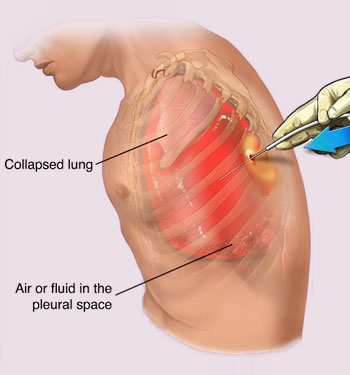
Types of Pneumothorax
1. Spontaneous Pneumothorax- Primary: Occurs without underlying lung disease
Common in tall, thin young males
Often due to rupture of small subpleural blebs - Secondary: Occurs in patients with underlying lung diseases
e.g., COPD, TB, cystic fibrosis, ILD
- Due to penetrating or blunt chest trauma, rib fractures, or iatrogenic causes
- Common during procedures like central line insertion, mechanical ventilation, or lung biopsy
- Air enters pleural space and cannot escape, increasing pressure
- Causes mediastinal shift, compression of heart and opposite lung
- Requires immediate needle decompression
Symptoms
- Sudden sharp chest pain
- Shortness of breath
- Rapid heart rate (tachycardia)
- Cyanosis (in severe cases)
- Decreased breath sounds on the affected side
- Hyperresonance to percussion
- Tracheal deviation (away from affected side in tension pneumothorax)
Prevention (for recurrent cases)
- Smoking cessation
- Avoid high-altitude, scuba diving, or air travel soon after recovery
- Surgical pleurodesis (for repeated episodes)